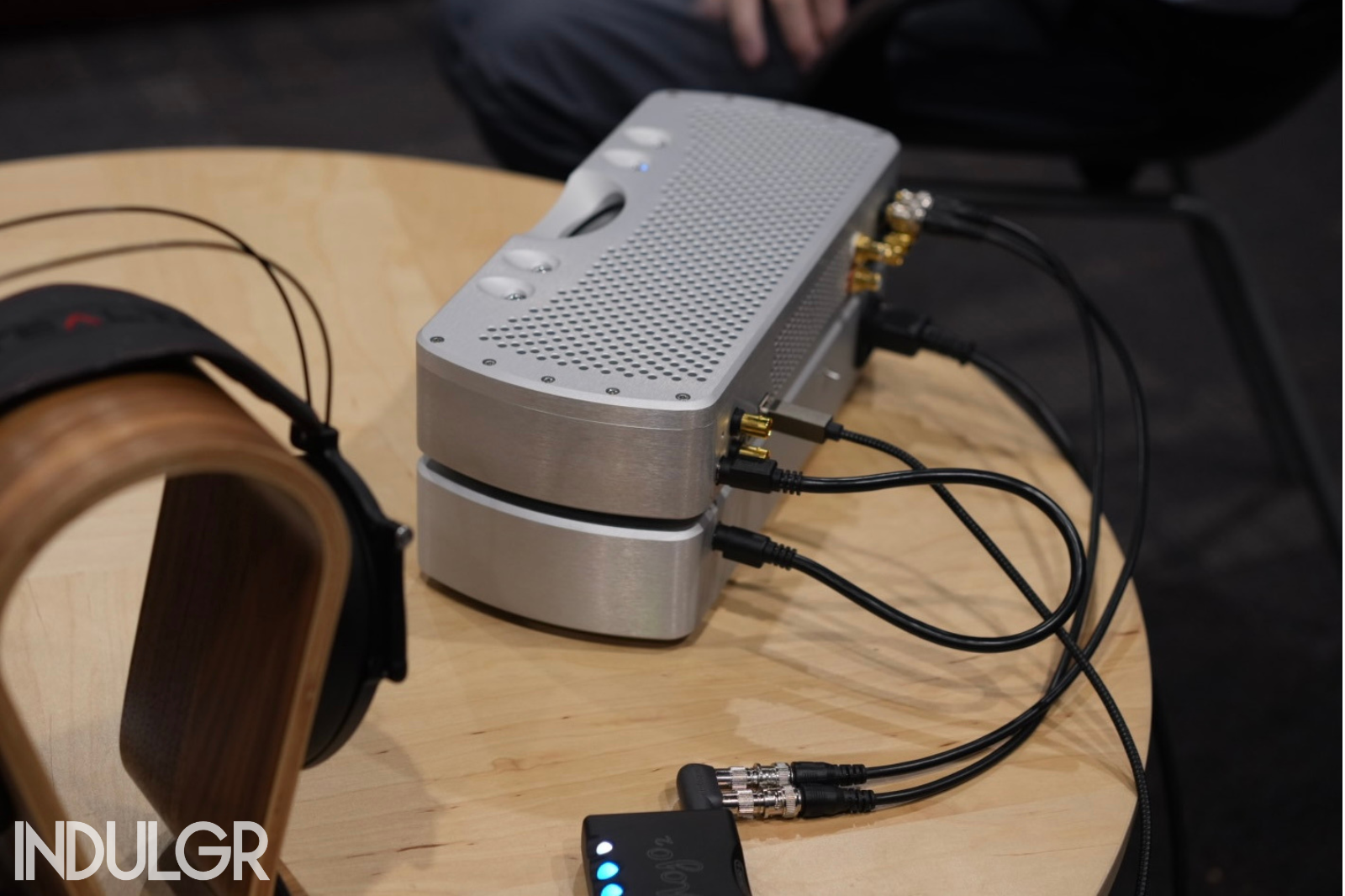




















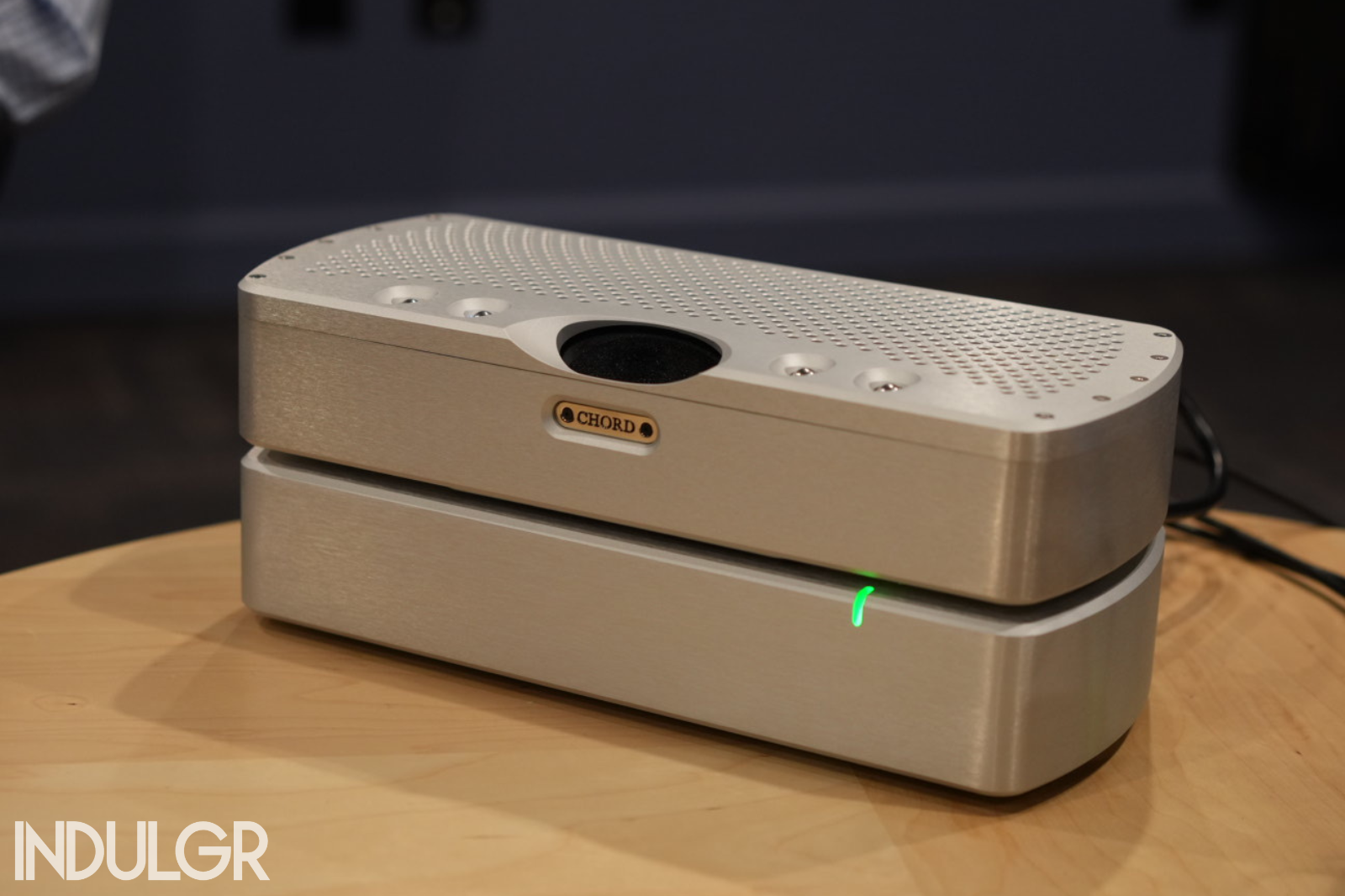
The other day, I was lucky enough to catch Rob Watts at one of my local Hi-Fi dealers in Atlanta, Hi-Fi Buys, where he was filming a video for the launch of the new Chord Electronics Quartet Scaler. He was kind enough to let me give the Quartet a listen. Being a former Chord dealer, now Hi-Fi publication owner and writer, I’ve had plenty of experience with the full Chord lineup both in-store and at home with a wide variety of 2ch and headphone systems. I’ve had Blu Mk2 in my systems as well as Hugo M-Scaler with Qutest, Hugo 2, Hugo TT2, and DAVE. I could ramble about parting with DAVE to better fit my few-year stint of a semi-nomadic lifestyle, or about how I finally settled down, started INDULGR, began construction on a no-holds-barred reference listening room from the ground up for review use, and got married. I could also go on about the contractor hell we’ve been in for the construction of said listening room, but I think you’d all rather just hear my Quartet impressions, so here they are.
Words and Photos by Jameson Mourafetis
Some of you have heard the Blu Mk2 or Hugo M-Scaler and know that impressions vary wildly from person to person. For some, the M-Scaler technology offers a subtle improvement, and for others, it’s a must-have that makes a greater difference than the choice of Chord DAC tier. For those of us who hear it and really get it, it can be puzzling that the magnitude of the impact varies so greatly, but I can say with confidence that Quartet just isn’t going to be like that. There’s nothing remotely subtle about the improvement the Quartet Scaler brings, and I’m confident that the range of listener reactions won’t be nearly as varied, at least not at the lesser end of the spectrum. Listening with headphones, specifically the DCA Stealth as well as my wife’s Abyss Diana Phis, the difference was stark. I’ll break it down into sections:
Imaging
For those of us who really enjoy the M-Scaler, the first standouts are imaging-related. Images are stable, dense, and solid. The edges of images are well defined. Space between images is definite. Focusing on individual images is easy. With the Quartet, all of this goes from something you can actively hear to something that becomes entirely effortless. These attributes are present but taken to a level where you don’t even have to focus or strain or try to hear them. It just happens. With live music, you don’t have to think about where each source is. They’re just there. Your brain doesn’t have to put it together. It’s second nature. Quartet is as close to this experience as I’ve ever heard with digital audio.
Stage Boundaries, Depth/Width/Height, Stage Coherence
Stage boundaries completely dissolved. Most of you are probably familiar with that eerie, lifelike “decay into empty space” feeling the M-Scaler brings in the Z axis and the extreme depth, but Quartet brings that quality to all dimensions. The decay into empty space extends to the sides, up and down, and of course, still behind images. Width, height, and depth of the images aren’t artificially stretched. It’s the space around them that expands. For live recordings, the space is recreated with much more extreme, lifelike scale in all directions with no emphasis on one particular direction. You no longer get just the narrower, depth-focused stage that the M-Scaler is known for. You get it all. There’s also no disconnect between “lobes” or “zones” to your front, sides, or areas at different heights like you often get with even some of the best headphone systems. The stage is completely coherent and without gaps in any direction.
Flow
This is an area that’s really difficult to describe. Some of you hear it with M-Scaler, some of you don’t, but with Quartet, it’s just so effortless and obvious. There’s a rigidity and stiffness and stiltedness to digital audio that most listeners would have trouble identifying without hearing it removed, and Quartet does just that. The music just flows. It’s “analog,” as cliché as that sounds. You’ll really just have to hear it to believe it. And for those of you who didn’t hear this attribute with the previous M-Scalers, I’m confident you will with Quartet.
Oh, and I guess at this point I should mention that this was all with a Quartet feeding a Mojo 2. Having heard Hugo M-Scaler with Qutest, Hugo 2, Hugo TT2, and DAVE, I’m certain the jump in performance with DAVE vs. Mojo 2 will be enormous, and I can’t wait to get a unit into my very nearly finished reference listening room.
For those of you who aren’t sure if the Quartet will be worth it at what I’m assuming will be a higher price than DAVE, I assure you, you’ll just have to hear it yourself. I think you’ll be surprised. As far as the effect it had on me: after years of waiting for Quartet to be released (and being a former Chord dealer, I knew about its development earlier than most), I had resigned to getting a much more expensive digital setup than DAVE+Quartet, but this rather brief listening session has upended those plans entirely. I can’t say definitively what my plans are without getting a unit in my room to test more extensively, but it’s hard to imagine Quartet won’t make its way into my reference system. Oh, and it’s also convinced me to repurchase DAVE.
This ended up being much longer than I intended, so my apologies for the rambling. Maybe it sounds over the top, but if it wasn’t clear, I was rather impressed by the long-awaited Quartet Scaler and had to get my thoughts down.
And I almost forgot to mention, I’m sure some of you have heard about the EQ feature mentioned by Darko and again in the CanJam preview video (and maybe earlier in this thread or over on the Watts Up thread?), but there’s also another surprise feature Rob managed to squeeze into Quartet: a line-level Pulse-Array ADC. More details on that to come soon, along with a full-scale review, but some of you will see for yourselves at CanJam this weekend, where the Quartet will be on display with DAVE. I’ll be there too. See you there!
I should also add that while the internals in the Quartet I heard are final, the casework is not, so expect it to look slightly different when it becomes available for sale later this year.